Saturday, November 6, 2021

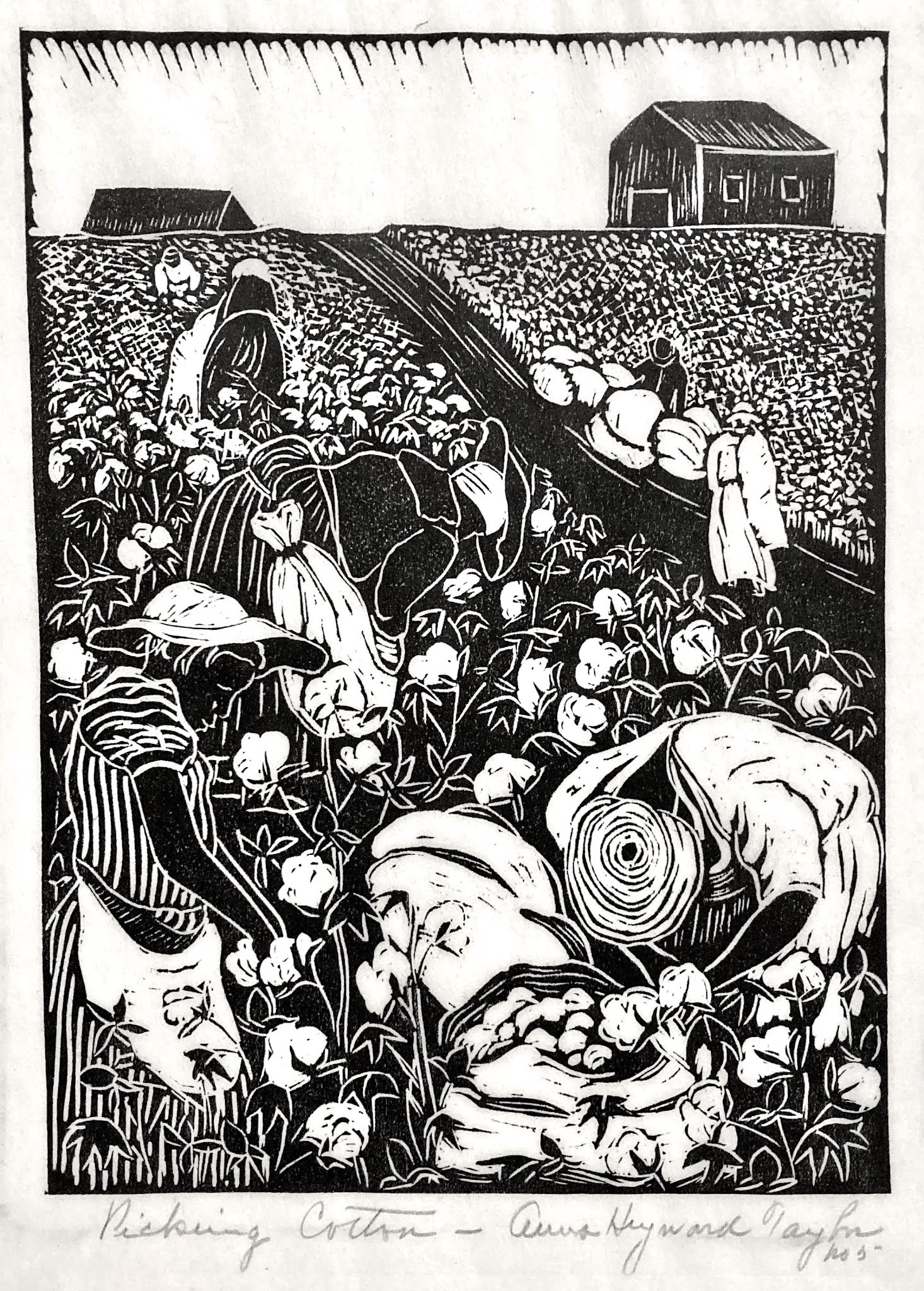
Anna Heyward Taylor, Picking Cotton, 1946


Anna Heyward Taylor, Picking Cotton, 1946


Born into a South Carolina family with ties to the cotton industry, Taylor (1879-1956) was well educated and well-traveled. She studied with William Merritt Chase in Holland, in 1903, visited Britain in 1904, France, and Switzerland in 1908, and Germany in 1909. In 1914 she traveled to China and Japan. At that point she entered a graduate program at Radcliffe College, and visited Provincetown, MA, where she studied with BJO Nordfeldt in 1915 and 16. Also in 1916 she went to British Guiana, and then back to France in 1917 and 19, and to Mexico from 1935 to 1936.


During the late teens and twenties Taylor was largely based in New York City; she made the permanent move to Charleston in 1929. There, along with Alice Ravenel Huger Smith, Alfred Hutty, and Elizabeth O’Neill Verner, she was part of the Charleston Renaissance.


This is a complex mid-twentieth century image. The medium of linocut, with strict black and white patterning, is exploited to show a bleak road and repeating puffs of cotton. The women’s clothes, while patterned, are basic and lacking decoration or charm. The top edge shows the gouges of a carving tool that adds traces of a naïve, home-spun ‘frame.’ At the same time it presents multi-faceted, highly charged social issues.


It is an insightful plunge into American history. Made for the publication of This is Our Land: The Story of the Agricultural Society of South Carolina, by Chalmers S. Murray, published by the Carolina Art Association, 1949, this impression has the notation No. 5, possibly referring to its placement in the series of images.


Of special importance is the group of figures working the long rows of plants – often it was women and children who were assigned this task. This references the brutal and rigid nature of the field management system in which the lead picker was among the most productive and the others in the row were pressed to keep up with her. Here they are deliberately un-regimented, shown in a more casual manner. Although they are clustered at the near left, there doesn’t seem to be any exchange between them. They work in isolation – each is alone and their group is apart from others that might be nearby. 


In the distance at the right is a building – a simple barn-like structure with a wide door -- probably awaiting the crop. At the far left is the roof of a building that might be a cabin. If this is a home of the field workers it is distant and un-inviting. While not exactly homeless, they seem adrift and aware that ‘home’ it isn’t particularly welcoming when they manage to return there.


Anne Heyward Taylor, working for a relatively objective, even scientific project, used the drama of a block print to examine the fine line between documenting current conditions that were difficult at best, while recalling those historically abhorrent. 


An impression of this subject is in the Gibbes Museum of Art, Charleston, South Carolina; it was donated by the artist.

Thursday, December 10, 2020

Vida Americana: Mexican/American Connections

The Vida Americana Show at the Whitney Museum of American Art (on view through January 31, 2021), features three artists we represent: Ben Shahn, Mitchell Siporin, and Harry Sternberg. In addition we're showing work by artists who are Mexican, Francisco Mora and Francisco Toledo, artists who traveled to Mexico or even, as in the case of Doris Rosenthal, established residences there, as well as work that shows the impact of this powerful moment.


                                  Judith Shahn, Bus Parking Lot, Mexico City, 1950


This is the link for the Gallery's Mexican/American Connections page:

http://www.susantellergallery.com/cgi/STG_art.pl?artist=vida


Vida Americana: Mural Studies

 The Vida Americana show at the Whitney Museum of Art inspired us to re-visit our own collection of American mural studies. They range from the Samuel Greeenburg 1940s rural scene at 6 x 8 to the 1940 Hugh Mesibov, Life of a Miner, at 63 inches. Some are early suggestions such as Louis Schanker's drawings for the World's Fair Mural, 1939, while others like Mordi Gassner's Coca Cola, a private submission of 1932, are finished in fine detail.


                            Harry Sternberg, Detail, Steel, 1937 


Link for the Gallery's Mural Studies page:

http://www.susantellergallery.com/cgi/STG_art.pl?artist=murals


Vida Americana: Racial Strife.

Please note that these images are disturbing.

The horrific phenomenon of lynching runs through the Vida Americana Show at the Whitney Museum of American Art. 

Our works were acquired over several decades. The artists range from the African-American New Yorker Vernon Poindexter and the Massachusetts-based Italian-American Umberto Romano, to the Cleveland-born Marion Campbell Kronfeld, who worked in Los Angeles, and Michael J. Gallagher, from the Pennsylvania coal fields.


Marian Campbell Kronfeld, Detail: Pieta, about 1940


This is the link to our Vida Americana: Racial Strife page:

http://www.susantellergallery.com/cgi/STG_art.pl?artist=strife


Sunday, November 1, 2020

IFPDA Fine Art Print Fair, 2020


Today is the last day of the IFPDA online virtual Print Fair available through Artsy. This past Friday we were so pleased to be included in ‘Swoon’s IFPDA’s Fine Art Print Fair Online Picks.’ Swoon, the artist Caledonia Curry, featured our Blanche Grambs lithograph Unemployed (also titled Depression), of 1935. She commented “The place where rest meets grief.” Definitely Grambs would have appreciated that. Thank you Swoon.


Blanche Grambs
                                Blanche Grambs, Unemployed (also titled Depression), 1935
 

#printfair #IFPDA #IFPDAprintfair #collectprints #newdeal #WPA #modernism #BlancheGrambs #PeggyBacon #MichaelJGallagher #RivaHelfond #AngeloPinto, #SalvatorePinto, and #HarrySternberg. There are modernist works by #WilliamBaziotes #HowardDaum #Sue Fuller #PeterGrippe #StanleyWilliamHayter #FannieHillsmith #Kett #DorothyBrowdyKushner #HughMesibov #BettyWaldoParish #BernardRosenquit #AnneRyan #LouisSchanker #KarlSchrag #AnseiUchima. 


Sunday, October 11, 2020

IFPDA Online Print Fair, Autumn, 2020


The Susan Teller Gallery is participating in the IFPDA Online Fine Art Print Fair, Online, Fall 2020, from October 7 through November 1. 


Here is the link:

https://www.artsy.net/show/susan-teller-gallery-susan-teller-gallery-at-ifpda-fine-art-print-fair-online-fall-2020


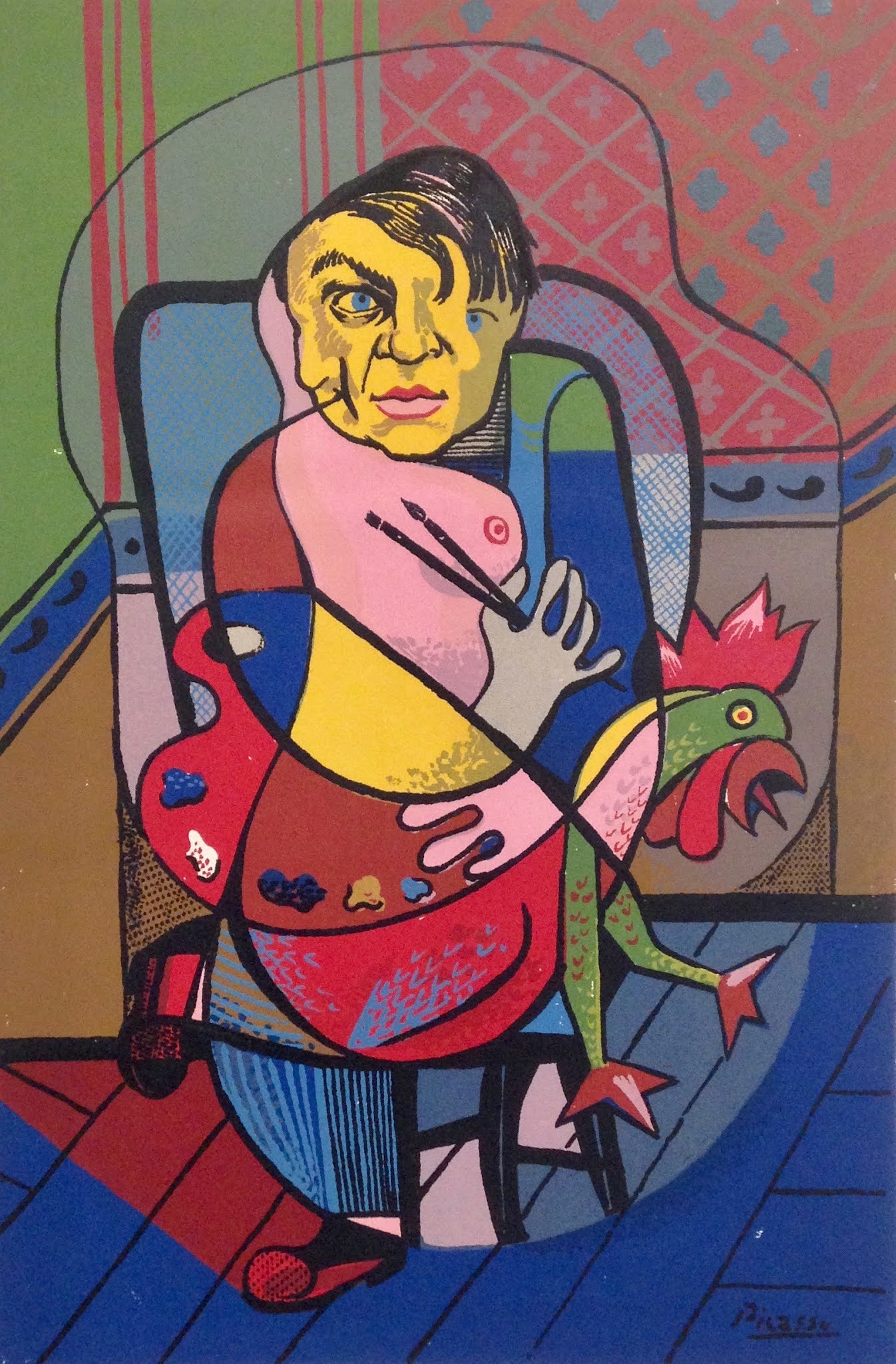
                                         Harry Sternberg, Pablo Picasso, 1944


Naturally we are remembering the many IFPDA fairs at the Park Avenue Armory (two with interruptions) and the recent three at the Javits Center and wishing we could be there welcoming visitors. But this year there is a pandemic and we are all adapting as well as we can.


For the 2020 virtual fair we are featuring figurative work from between the wars – including the new Deal Era -- with prints by Peggy Bacon, Michael J. Gallagher, Riva Helfond, Angelo Pinto, Salvatore Pinto, and Harry Sternberg. There are modernist works by William Baziotes, Howard Daum, Sue Fuller, Peter Grippe, Stanley William Hayter, Fannie Hillsmith, Kett, Dorothy Browdy Kushner, Hugh Mesibov, Betty Waldo Parish, Bernard Rosenquit, Anne Ryan, Louis Schanker, Karl Schrag, and Ansei Uchima. 


#printfair #IFPDA #IFPDAprintfair #collectprints #newdeal #WPA #modernism #PeggyBacon #MichaelJGallagher #RivaHelfond #AngeloPinto, #SalvatorePinto, and #HarrySternberg. There are modernist works by #WilliamBaziotes #HowardDaum #Sue Fuller #PeterGrippe #StanleyWilliamHayter #FannieHillsmith #Kett #DorothyBrowdyKushne #HughMesibov #BettyWaldoParish #BernardRosenquit #AnneRyan #LouisSchanker #KarlSchrag #AnseiUchima. 

Tuesday, May 19, 2020

THE IRASCIBLES


Seventy years ago tomorrow, May 20, 1950, the New York Times published a letter to Roland L. Redmond, President of the Metropolitan Museum of Art. It protested the selection of the museum’s ‘American Painting Today -- 1950’ exhibition and was signed by eighteen American painters, including William Baziotes, as well as ten sculptors, including Peter Grippe.
 
William Baziotes, Clown and Clock, 1943-46

The group was critical of the makeup of the juries: Among the jurists were Charles Burchfield, Yasuo Kuniyoshi and Millard Sheets. The next day, May 21, a competing paper, The Herald Tribune, published an article, presumably by their art critic Emily Genauer, defending the Museum and calling the protestors ‘The Irascible 18.’

Peter Grippe, Daley Brothers' Moving, 1944

On July 3, 1950, seventy-five artists issued a statement defending the museum. Among them were Will Barnet, Philip Evergood, Reginald Marsh, and Harry Sternberg. 

Detail of Nina Leen's photograph for Life Magazine, with identification.

Generally now known as the New York School, most of the protestors were photographed by Nina Leen for Life Magazine’s January 15, 1951, issue. It was Barnett Newman (who also largely composed the letter), who suggested that they should look like bankers.

TheIrascibles, TheIrascible18, AmericanPaintingToday, WilliamBaziotes, PeterGrippe, EmilyGenauer, WillBarnet, ReginaldMarsh, MillardSheets, HarrySternberg, TheNewYorkTimes, NewYorkTimes, TheHeraldTribune, HeraldTribune, LifeMagazine, MetropolitanMuseumofArt, MetropolitanMuseum, NinaLeen, NewYorkSchool

#TheIrascibles #TheIrascible18 #AmericanPaintingToday #WilliamBaziotes #PeterGrippe #EmilyGenauer #WillBarnet #ReginaldMarsh #MillardSheets #HarrySternberg #TheNewYorkTimes #NewYorkTimes #TheHeraldTribune #HeraldTribune, #LifeMagazine, #MetropolitanMuseumofArt #MetropolitanMuseum #NinaLeen #NewYorkSchool