 |
| Alfred Bendiner (1899-1964), Kiosk, about 1950, lithograph, 7 x 6 inches |
Tuesday, November 17, 2015
PARIS, November, 2015
Our thoughts are with Paris.


Saturday, November 7, 2015
New York PRINT FAIR
-->

Saturday, November 7 (Noon to 8) and Sunday, November 8 (Noon to 6.)
This year we will
celebrate the 80th Anniversary of the signing of the Works Progress
Administration (WPA) into law in 1935 as well as the founding of the New York
Atelier 17 in 1940. We hope to see you at the Park Avenue Armory between 66th
and 67th Streets. Booth 116 -- that's the north-east corner of the room -- go
to the far left aisle and walk towards the back, to the Lexington Avenue side
of the building.
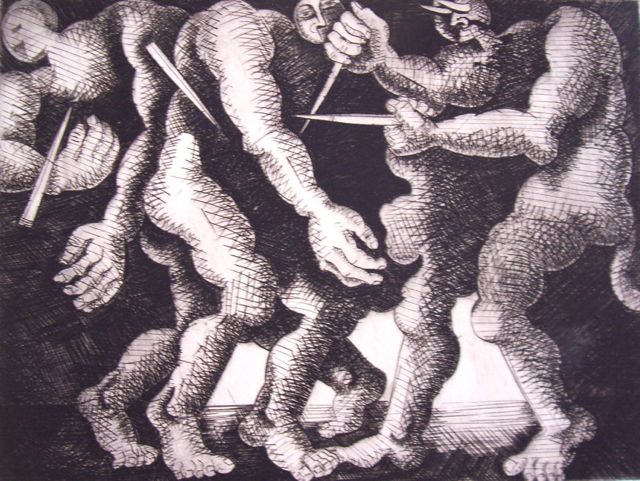
We were in a bit of a rush setting up, and I still haven't shot the whole booth, but this is a view of the East Wall (Lexington Avenue Side) showing, at the left, the two states and final version of the Howard Daum's Combat, 1947. It is a perfect storm of Guernica tribute, Hans Hofmann inspiration, Indian Space composition, and Atelier 17 technique, combined with Daum's relationship with Stanley William Hayter, Picasso's friend and printer.

Saturday, October 24, 2015
ART FOR EVERY HOME
-
This week I received the brand-new publication
Art for Every Home, Associated American Artists, 1934-2000. Hats off to
Elizabeth G. Seaton, Jane Myers, and Gail Windisch, who stuck with this project
and saw it to completion. Special congratulations to Windisch. She catalogued
the nearly 3000 AAA editions.

Until now the world has had only the list compiled by Meg Dunwoody Hausberg in, well, after the Selectric typewriter but years and years before the personal computer. That precious document has saved me many times. But now, NOW the book has a complete checklist of the AAA prints as well as instructions for downloading the FREE complete catalogue. The book is beautifully designed with tons of illustrations including two shots of Meg’s and my ol’ boss Sylvan Cole.

Until now the world has had only the list compiled by Meg Dunwoody Hausberg in, well, after the Selectric typewriter but years and years before the personal computer. That precious document has saved me many times. But now, NOW the book has a complete checklist of the AAA prints as well as instructions for downloading the FREE complete catalogue. The book is beautifully designed with tons of illustrations including two shots of Meg’s and my ol’ boss Sylvan Cole.
Eventually there will be lots more about
this project, but for now let’s just celebrate and say an enormous thank you to
Liz, Jane, and especially Gail who worked on it the longest and initiated the
catalogue. It’s a HUGE job well done.
The related exhibition is currently on view at
the Beach Museum of Art, Kansas State University, through January 31, 2016 –
still kicking myself for not going to that reception. It will be in NYC in the
spring, at the Grey Art Gallery of New York University, from April 19 through
July 9, 2016.
#ArtforEveryHome, #AssociatedAmericanArtists,
#AAA, #ElizabethSeaton, #JaneMyers, #GailWindisch, #MegDunwoodyHausberg, #MargaretDunwoodyHausberg
#SylvanCole.
Saturday, October 10, 2015
BLACK MOUNTAIN
-->
In the summer of 1948 Peter Grippe taught sculpture there; in addition to Albers his colleagues were Willem de Kooning, Buckminster Fuller, Merce Cunningham, and Beaumont Newhall.
Leap Before You Look: Black Mountain College,
1933-1957, runs from October 10 through January 24, 2016, at the Institute of
Contemporary Art, Boston.
 |
| Josef Albers, Prefatio, 1942 |
Of course, Josef Albers was a key figure; he taught
there from 1933 to 1949.
 |
| Fannie Hillsmith, The House, 1946 |
Fannie Hillsmith (1911-2007) taught at Black Mountain
in 1945 at the invitation of Albers. In 1996 she and I travelled together to
Asheville, North Carolina, when their archives honored her with a one-woman
show. We visited the college grounds and even though it had been turned into a
summer camp she could still see traces of the original layout.
 |
| Peter Grippe, Death of the Heros, 1952 |
In the summer of 1948 Peter Grippe taught sculpture there; in addition to Albers his colleagues were Willem de Kooning, Buckminster Fuller, Merce Cunningham, and Beaumont Newhall.
Franz Kline (1910-1962) taught there in 1952.
 |
| Franz Kline, Bather Drying Her Hair, about 1945 |
Link to Gallery site:
http://www.susantellergallery.com/cgi/STG_art.pl?artist=btmt
Saturday, October 3, 2015
Appreciating the New Whitney
-->
-->
The new Whitney Museum of American Art’s
inaugural exhibition, America Is Hard to See, closed on September 27. It was a
great start. Of course, most of my time was spent in two places.
 |
| Peggy Bacon, Lloyd Goodrich |
On the first floor there was the wonderful room
dedicated to the history of the museum, with Peggy Bacon’s Whitney Studio Club
drypoint – PERFECT! Bacon knew Lloyd
Goodrich, art historian and long-time Whitney curator who became director in
1958.
On the top exhibition floor (mostly the show
went chronologically down from the top) there were the protest pieces from the
1930s. There was entire wall devoted to
scenes of lynching including Harry Sternberg’s Southern Holiday, 1935, adjacent to
works by Ben Shahn and Bernarda Bryson Shahn. In more serene areas there were
works by Joe Jones and Louis Lozowick.
 | ||||
|
Monday, September 7, 2015
HONORING LABOR
-->
Inspired by
Randy Kennedy's wonderful New York Times article on Labor Day subjects in NYC
museums, September 5, 2015, we’ve grouped a few favorites by Peggy Bacon, Fred
Becker, Bernarda Bryson Shahn, Michael J. Gallagher, Hugo Gellert,
Riva Helfond, Axel Horn, Charles Keller, Hugh Mesibov, Betty Waldo Parish,
Angelo Pinto, Albert Potter, Ben Shahn, Mary Sinclair, Mitchel Siporin, William
E. Smith, Harry Sternberg, and Lynd Ward.
This is the link:
http://www.susantellergallery.com/cgi/STG_art.pl?artist=laborday
 |
| Riva Helfond, Curtain Factory, 1937, oil on canvas, 24 x 30 inches. |
Have a wonderful holiday!
Saturday, August 29, 2015
Day Trip to FRIDA KAHLO Show at the New York Botanical
-->
Frida Kahlo: Art • Garden • Life
On view through November 1, 2015
The entrance alone is worth the trip to the New
York Botanical Garden. They’ve done a wonderful job of making it welcoming and
grand. Right off the bat, the taco truck is just past the entrance alongside
the rolling lawns, the grand vistas, and the giant poster for the Frida Kahlo
show on the Mertz building.
 |
| The Mertz Building with the poster for the Frida Kahlo show. |
The Frida Kahlo: Art, Garden, Life, in the
LuEsther T. Mertz Library, and curated by Adriana Zavala, is remarkable. It’s
select but inclusive with her fabulous Self Portrait with Thorn Necklace and
Hummingbird, 1940. Her pet monkey and cat watch over her and look around at the
same time – clearly they are not just pets -- they are familiars. Then there is
the jungle surround. Used on the poster for the show, it makes it clear that
this show is at the Botanical Garden and we better get used to it.
The paintings and drawings are heavy on still
life subjects and each has it’s own magic. At once formal and luscious they
lead into the more scientific part of the show: Case after case of botanical
specimens, illustrations, references, and notes, all concerning the flora used
by Kahlo. These speak to the most casual visitors, all manner of gardeners,
professional botanists, and the hard-core Kahlo enthusiasts. Following botany are maps and photographs documenting her reverence for Mexico City. We
even see her with Rivera in the ancient floating gardens of Xochimilco.
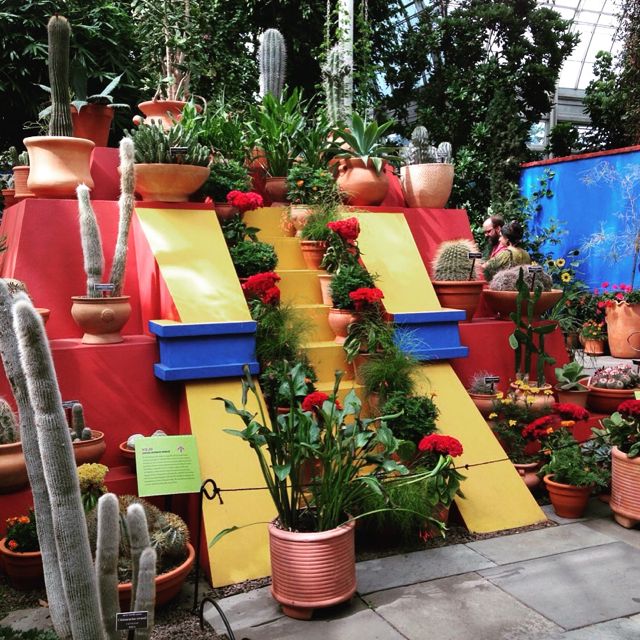 |
| Reconstruction of Kahlo and Rivera's Casa Azul |
A stroll or tram ride away is the second part of
the show, Frida Kahlo: Garden. There, in the Haupt Conservatory, we encounter a
re-imaging of Kahlo and Diego Rivera’s Case Azul. Originally constructed in the
garden of Kahlo’s family home, it is an Aztec-inspired construction built to
hold Rivera’s pre-Hispanic collection. Here it’s used for Mexican cacti and succulents
in traditional terra cotta pots. Nearby are re-created versions of their “frog
fountain” and Kahlo’s desk. All told there are masses of the native species that
the couple favored; in addition to the cacti and succulents, there are cock’s
comb, dahlias, zinnias, and, giving many visitors an entirely new appreciation
of an old standby, marigolds. These are the two-foot tall Mexican natives known
as the African Marigolds; the name in Aztec means “twenty flowers.” They are also
associated with death and used to decorate graves for All Souls’ Day. Outside
at the lily pond a greenhouse wall hosts a pipe organ cactus fence recalling the
one at Rivera’s studio in San Angel.
 |
| Recreation of Diego Rivera's Pipe Organ Cactus Fence |
In Kahlo’s endlessly complex and fraught world
somehow botanical science is layered with marriages, with Mexican art, social
history, and urban life, as well as with racial and medical issues.
Subscribe to:
Posts (Atom)
