Saturday, October 3, 2015

Appreciating the New Whitney

-->
--> The new Whitney Museum of American Art’s inaugural exhibition, America Is Hard to See, closed on September 27. It was a great start. Of course, most of my time was spent in two places.

Peggy Bacon, Lloyd Goodrich

On the first floor there was the wonderful room dedicated to the history of the museum, with Peggy Bacon’s Whitney Studio Club drypoint – PERFECT! Bacon knew Lloyd Goodrich, art historian and long-time Whitney curator who became director in 1958.


On the top exhibition floor (mostly the show went chronologically down from the top) there were the protest pieces from the 1930s.  There was entire wall devoted to scenes of lynching including Harry Sternberg’s Southern Holiday, 1935, adjacent to works by Ben Shahn and Bernarda Bryson Shahn. In more serene areas there were works by Joe Jones and Louis Lozowick.  


Harry Sternberg, Detail: Southern Holiday, 1935


Monday, September 7, 2015

HONORING LABOR

-->
Inspired by Randy Kennedy's wonderful New York Times article on Labor Day subjects in NYC museums, September 5, 2015, we’ve grouped a few favorites by Peggy Bacon, Fred Becker, Bernarda Bryson Shahn, Michael J. Gallagher, Hugo Gellert, Riva Helfond, Axel Horn, Charles Keller, Hugh Mesibov, Betty Waldo Parish, Angelo Pinto, Albert Potter, Ben Shahn, Mary Sinclair, Mitchel Siporin, William E. Smith, Harry Sternberg, and Lynd Ward.

This is the link:
http://www.susantellergallery.com/cgi/STG_art.pl?artist=laborday


Riva Helfond, Curtain Factory, 1937, oil on canvas, 24 x 30 inches.


Have a wonderful holiday!

Saturday, August 29, 2015

Day Trip to FRIDA KAHLO Show at the New York Botanical

-->
Frida Kahlo: Art • Garden • Life
On view through November 1, 2015

The entrance alone is worth the trip to the New York Botanical Garden. They’ve done a wonderful job of making it welcoming and grand. Right off the bat, the taco truck is just past the entrance alongside the rolling lawns, the grand vistas, and the giant poster for the Frida Kahlo show on the Mertz building.

The Mertz Building with the poster for the Frida Kahlo show.

The Frida Kahlo: Art, Garden, Life, in the LuEsther T. Mertz Library, and curated by Adriana Zavala, is remarkable. It’s select but inclusive with her fabulous Self Portrait with Thorn Necklace and Hummingbird, 1940. Her pet monkey and cat watch over her and look around at the same time – clearly they are not just pets -- they are familiars. Then there is the jungle surround. Used on the poster for the show, it makes it clear that this show is at the Botanical Garden and we better get used to it.

The paintings and drawings are heavy on still life subjects and each has it’s own magic. At once formal and luscious they lead into the more scientific part of the show: Case after case of botanical specimens, illustrations, references, and notes, all concerning the flora used by Kahlo. These speak to the most casual visitors, all manner of gardeners, professional botanists, and the hard-core Kahlo enthusiasts. Following botany are maps and photographs documenting her reverence for Mexico City. We even see her with Rivera in the ancient floating gardens of Xochimilco.


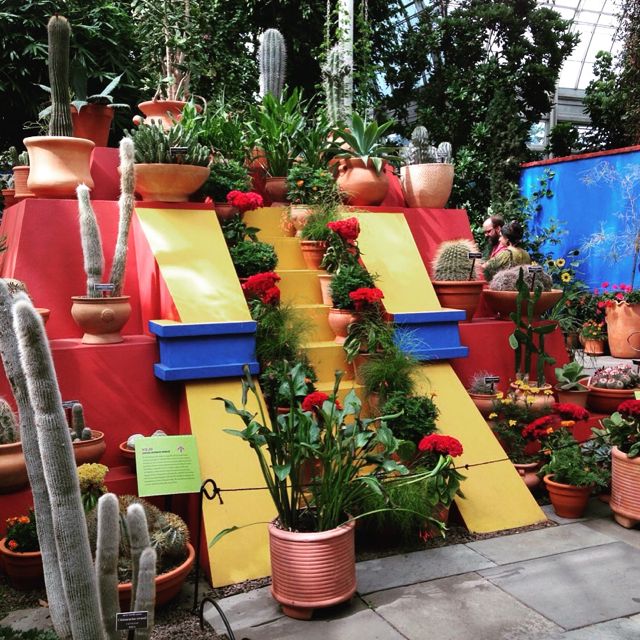
Reconstruction of Kahlo and Rivera's Casa Azul
A stroll or tram ride away is the second part of the show, Frida Kahlo: Garden. There, in the Haupt Conservatory, we encounter a re-imaging of Kahlo and Diego Rivera’s Case Azul. Originally constructed in the garden of Kahlo’s family home, it is an Aztec-inspired construction built to hold Rivera’s pre-Hispanic collection. Here it’s used for Mexican cacti and succulents in traditional terra cotta pots. Nearby are re-created versions of their “frog fountain” and Kahlo’s desk. All told there are masses of the native species that the couple favored; in addition to the cacti and succulents, there are cock’s comb, dahlias, zinnias, and, giving many visitors an entirely new appreciation of an old standby, marigolds. These are the two-foot tall Mexican natives known as the African Marigolds; the name in Aztec means “twenty flowers.” They are also associated with death and used to decorate graves for All Souls’ Day. Outside at the lily pond a greenhouse wall hosts a pipe organ cactus fence recalling the one at Rivera’s studio in San Angel.
 
Recreation of Diego Rivera's Pipe Organ Cactus Fence
In Kahlo’s endlessly complex and fraught world somehow botanical science is layered with marriages, with Mexican art, social history, and urban life, as well as with racial and medical issues.

Saturday, August 22, 2015

BAZIOTES IN ALLENTOWN -- LAST TWO DAYS !!!

 
LAST TWO DAYS
On view through Tomorrow, Sunday, August 23, 2015

WILLIAM BAZIOTES: SURREALIST WATERCOLORS
Allentown Art Museum
31 North Fifth Street, Allentown, PA

How is it possible? The summer is nearly over and so is the Baziotes show!

The museum notes “Baziotes (1912-1963) was an important contributor to Abstract Expressionism who also upheld the mysterious, dreamlike, and poetic aspects of Surrealism.”

In the Reading Eagle art critic Ron Schira wrote “This impressive exhibition of Baziotes' early work offers insight toward understanding his enigmatic later work; the pieces are painted lightly but the subject matter is dark in a bold, tragicomic irony.”

Figure with Sunlamp, 1936-39


These drawings are early, 1936 to 1939. They are pre-Abstract Expressionism and pre-World War II. It is Surrealism of swimmers menaced by lightening, bulls raising their fists, and struggling pictographs. Sometimes, however, there is a bizarre joie de vivre: sunbathing girls with multiple body parts on city rooftops. The frequent use of gouache adds brightness and intense color.

Greek-American William Baziotes (1912-1963) was born in Pittsburgh and raised in Reading, Pennsylvania, where an early mentor was the poet Byron Vazsakas. In 1931 Baziotes saw an exhibition of work by Henri Matisse at the Museum of Modern Art. It was a defining experience and he moved to New York City in 1933. He attended the National Academy of Design and worked with Charles Curran, Ivan Olinsky, Gifford Beal, and Leon Kroll. He graduated in 1936 and then worked on the Works Progress Administration. He was a teacher at the Queens Museum of Art, 1936-38, and an easel painter, 1938-40. 


Baziotes around 1940
In 1936 Baziotes met the surrealist Giorgio de Chirico and he showed his work for the first time, at a group show at the Municipal Art Gallery. By 1940 he knew Jimmy Ernst, Gordon Onslow-Ford, Gerome Kamrowski, Andre Masson, Roberta Matta, and Jackson Pollock. Also in 1940 Baziotes exhibited with the surrealists in a group show at the New School.

Baziotes attended Stanley William Hayter’s printmaking studio, Atelier 17, which opened its New York venue in 1940. It was a gathering place for the European ex-patriots and the American modernists; automatism was a frequently used technique and subject of endless discussion. The work Collaborative Painting, an exercise in automatism, made by Baziotes, Gerome Kamrowski, and Jackson Pollock, is dated 1940-41.

In 1941 Baziotes married Ethel Copstein; they lived in Morningside Heights. Also that year Matta introduced Baziotes to Robert Motherwell. In 1942, at the invitation of Masson, Baziotes showed with Motherwell and David Hare in the First Papers of Surrealism show at the Whitelaw Reid Mansion. However, he was gradually drawn to abstraction and eventually became one of The Irascible Eighteen (artists who protested the more traditional views of the Metropolitan Museum of Art).

Baziotes’ first one-man show was at Peggy Guggenheim’s Art of This Century Gallery in 1944. A show in 1946 at the Kootz Gallery established representation that continued until 1958. In 1948, with David Hare, Robert Motherwell, and Mark Rothko, Baziotes founded the Subjects of the Artist School on East Eighth Street. He taught at the Brooklyn Museum School, the Museum of Modern Art, Hunter College, and New York University.

Creature on Red Ground, 1936-39

In 1962 his work was in the landmark show Ten American Painters at the Sydney Janis Gallery. In the 1965 the Guggenheim Museum held a Memorial Exhibition.

In 2012 the Reading Public Museum held a 100th Anniversary Exhibition, and William Baziotes, A Centennial Exhibition, Drawings of the 1930s, was shown at the Susan Teller Gallery, New York, NY.

#WilliamBaziotes #Baziotes #AllentownArtMuseum #AtownArtMuseum #PeggyGuggenheim #SydneyJanis #Surrealism #Motherwell #Matta #Kamrowsky #Pollock #Pittsburghborn #Pittsburg, #Pittsburghartist #Reading #SubjectsoftheArtistSchool #TheIrascibleEighteen

Saturday, August 15, 2015

MoMA's Jacob Lawrence Show

The Museum of Modern Art did a wonderful job with the Jacob Lawrence One-Way Ticket show. They are presenting the entire 60 panels of The Migration Series, 1940-41 (made when Lawrence was 23). Shown in one room, the tempera drawings on hardboard panels are single-spaced in clockwise order, all in simple wood frames. Clearly modernist in style, they were conceived as a narrative at the very time that the New York art world was moving away from storytelling.

Harry Sternberg, Steel, 1937-38, oil on masonite, 24 x 48 inches
Born in Atlantic City, NJ, and raised in Harlem, New York City, Lawrence (1917-2000) researched his subject with the help of his future wife, the artist Gwendolyn Knight. He went into amazing detail in both the pictures and the captions, using the First World War as his jumping off point. He analyzed the recruitment by agents for factories -- especially steel mills, and the use of railroads for transportation but also source of jobs leading to one of the first Black labor unions -- the Brotherhood of Sleeping Car Porters, in spite of opposition from the Pullman Company. The travels costs were usually paid by employers to be re-reimbursed from future pay envelopes.

Lawrence drew scenes that referenced lynching and law enforcement, as well as floods and insect infestations that had drastic effects on farming. He noted the North was NOT free of racism, and that women labors and Black professionals such as doctors were along the last to make the transition. He considered the emotional toll of families now in crowded urban conditions and the lonely relatives in small southern towns that they had left behind. Improved childhood education was an important motivation, but the anxiety of the children is nearly palpable. He even discussed, with touching sympathy, the plight of communities emptied of their labor forces. His own parents, from South Carolina and Virginia, were part of this great shift north that really ended only in the 1970s, so this saga was personal. In the hallway leading to the show there’s a timeline showing the increase of African Americans from tens of thousands in the teens to hundreds of thousands over just a few decades. Philadelphia, Chicago, Detroit, and especially New York City, were the primary beneficiaries.

Lawrence achieved such mastery that while the works form a unified cycle, each individual piece can stand alone. The Migration Series was first shown by Edith Halpert at her Downtown Gallery, NYC, in 1942, and subsequently went on a two-year national tour. The Museum of Modern Art and the Phillips Collection acquired half each. In what must have seemed like a flash, Lawrence’s career was established. In 1944, while in the Coast Guard, he had a one-man show at the Museum of Modern Art.

In this show dealing with the “Great Movement North” MoMA included related photographs with several of Arkansas and Tennessee by Ben Shahn, additional works by Lawrence and African-American colleagues, and an extensive collection of publications, largely books of the period with their amazing covers. Music and historical and sociological information enrich the experience as well.

Above is Harry Sternberg’s Steel, 1937-38. It just wasn’t in me to use his Southern Holiday. Even Lawrence wasn’t that literal.


Sunday, August 9, 2015

Return to the WILLIAM BAZIOTES SURREALIST WATERCOLORS SHOW IN ALLENTOWN

There are only a few more weeks to see the William Baziotes show at the Allentown Art Museum, so we made a return visit.


Columbia Country Courthouse
Approaching Allentown from the northwest we visited Broomsburg, the Columbia County seat.  An impressive courthouse on Main Street was begun in 1848, has an 1868 addition, and a newer  front building and facade from 1980, designed by A. S. Wagner in classic Romanesque Revival brownstone. To the courthouse’s west there is a wonderful Art Deco building, with the name of The Farmers National Bank still visible. In the nineteenth century Bloomsburg went through iron ore mining and production and textile manufacturing. These industries apparently produced civic-minded citizens who wanted a town they could be proud of, with a fountain, civil war monument, and park-like avenues. The town planning and old houses are fascinating. On Market Street the (probably) biggest of the turn-of-the-century mansions looks down on the town from it’s centered and elevated site. 

Travelling from Bloomsburg to Allentown we went through the Lehigh Tunnel through Blue Mountain. It’s wonderful country with fabulous views of the Pocono Mountains with forests, small towns, and farmland.

William Baziotes, Yellow Bull's Head, 1936-39


                     At the Allentown Art Museum, the William Baziotes Surrealist Watercolors show was as wonderful as ever. Seeing it a second time was revelatory! It was all so fresh and bright. But that made the lightening threating the swimmer more dangerous and the bulls’ heads more ferocious. 

The circus-themed amoebas were outdoing themselves, and the gritty roof tiles under the Sunbather practically sparkled. On view through August 23.

William Baziotes, Two Figures in Trapeze Act, 1936-39


Doylestown was our next stop. The Michener Art Museum was showing Iron and Coal, Petroleum and Steel: Industrial Art from the Steidle Collection (owned by Pennsylvania State University), on view through October 25. With the exception of Rockwell Kent and Henry Varnum Poor, most of these New Deal Era artists were unknown to me, including a new favorite, Molly Wheeler Wood Pitz. Using categories of Big Steel, The Worker, and King Cole, and including glass blowing and stone quarries, the curator, Kirsten Jensen allowed the grandeur of the subjects to speak for themselves. All the drama of blast furnaces and night-shift mining comes through, along with grim realities of the soot-coated houses and hardly conscious laborers. Definitely my kind of show.  Thank you Bill M.

Sunday, August 2, 2015

Whistler and Roussel: Linked Visions


On Thursday, July 16 we visited the Art Institute of Chicago to see Whistler and Roussel: Linked Visions. The paintings, drawings, and especially the prints of friends James McNeill Whistler and Theodore Roussel are on view along with letters, menus, copper plates, and Roussel frames. This wide-ranging show also explores their relationships with colleagues Frank Duveneck, Francis Seymour Haden, Paul Cesar Hellue, Mortimer Mempes, Joseph Pennell, and Walter Sickert.

Curators Meg Hausberg and Victoria Sancho Lobis wrote in the on-line catalogue, “We hope that this exhibition will remind those who already admire James McNeill Whistler of his remarkable commitment to the art of printmaking, and at the same time, we aim to inspire new admiration for Theodore Roussel, whose quieter nature and preference for process over product has kept him well in the shadow of his more prolific and flamboyant peer.” It is a remarkable privilege to stand within reach of Whistler’s beautifully inked views of London or Venice and with Roussel’s intimate daily scenes, his progressive states and experiments, or his amazingly complex color compositions.

Link to on-line catalogue:https://publications.artic.edu/whistler/reader/linkedvisions/section/409